
If, while attending a wedding reception, a server accidentally spills champagne on you, you’ll probably be annoyed, even angered, and then that’s it.
Not so for nail polish brand OPI founder Suzi Weiss-Fischmann. When her clothes got splattered, she took note of how, after apologizing to her, the server added “I’m not really a waitress,” thereby reminding Weiss-Fischmann that the city both were in – Los Angeles – is full of people hoping to break into film and taking on service jobs on the side just to make ends meet.
That random remark led to the creation of one of OPI’s most beloved colors, a deep red with a subtle glitter christened “I’m not really a waitress” (when the time came for the beauty entrepreneur to write her memoirs, this phrase became her book’s title).
“I’m Not Really a Waitress was a playful nod to our neighborhood, but it also spoke to anyone laboring for a dream,” Weiss-Fischmann explains in her book. “Maybe your dream is to be an artist but for the meantime you’re working a corporate job. The message we wanted to send is that you can be anything you want to be, and that dreams are worth pursuing.”
I love how this story shows someone transforming a mundane event into a source of inspiration. It’s a reminder that creativity isn’t about waiting for lightning to strike, but about being open to the hidden stories that are unfolding around one.
Success in creative writing depends as much on this mindset as on English proficiency. The other day, a student of mine chose to write on this topic:
“Write about a place that shaped who you are. This could be a city, a room, a natural space – anywhere that holds lasting significance for you.”
As I worked on my version of the topic – I teach writing by writing along with my students – I cast my imagination wide and opened myself up to whimsical ways of interpreting the words “place” and “space.” Here is the fruit of that effort.
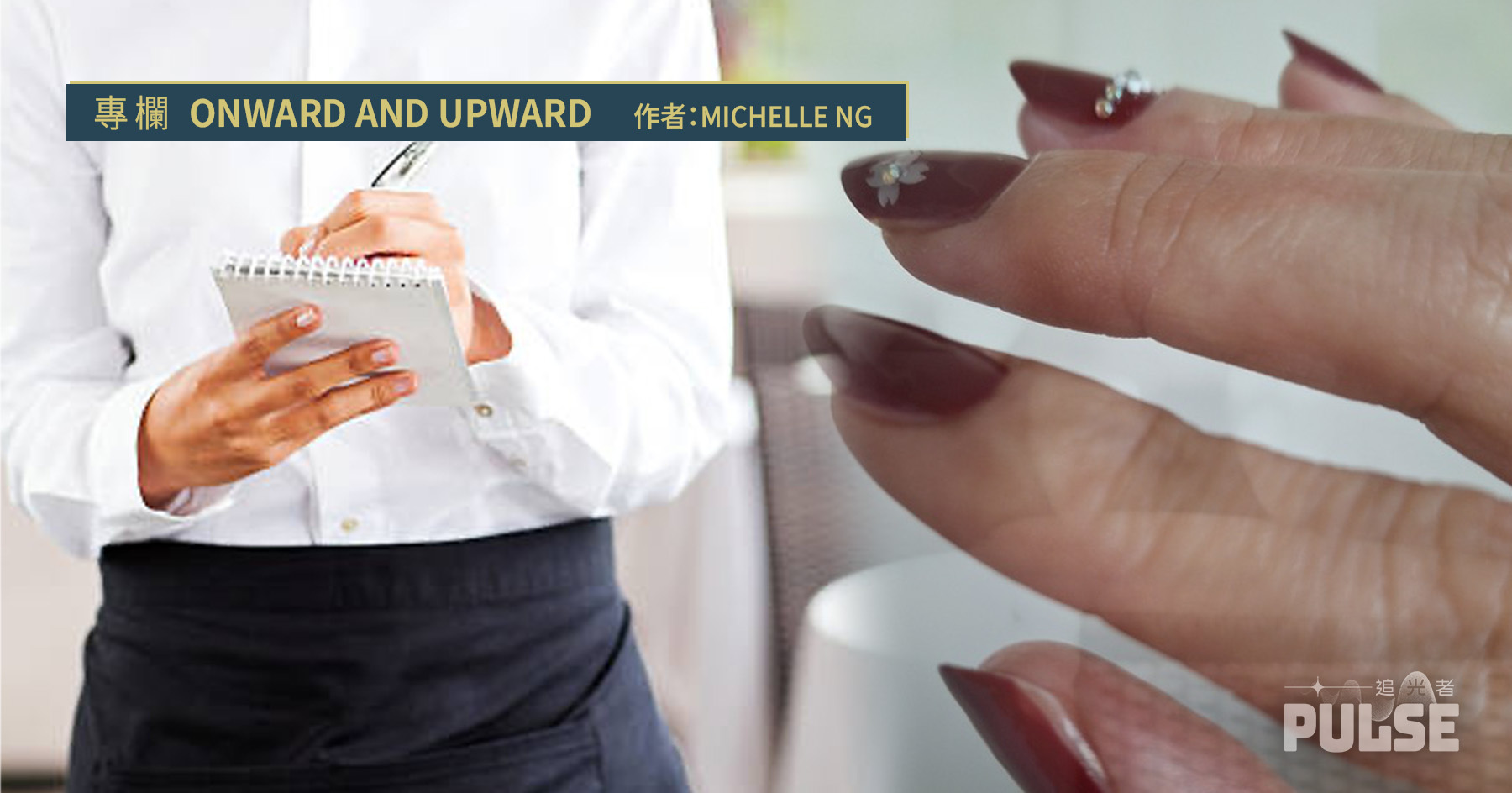
Buddhists believe that the mysteries of the universe can be embodied in a single flower. As a DIY nail enthusiast, I believe my worldly strivings are reflected in the space between my cuticles and the edges of my nail polish.
When I paint my nails, I like to create the illusion of longer nail beds by leaving a tiny, unpainted margin on each side of a nail. This labour is a delicate balancing act: I must load the brush with just the right amount of polish to avoid flooding my cuticles; I must apply the color in fluid swipes to keep the contours smooth; I must ensure that the width of each margin remains the same across all ten fingers, in order to maintain a uniform look. Achieving this level of precision with my dominant hand is difficult enough, but the true test of dexterity lies in doing it all over again with my non-dominant hand. This is why nail bars are everywhere. Many women can’t do their nails without making a mess; even those who are skilled with their dominant hand struggle once it is their other hand’s turn to pick up the brush.
When I started teaching myself DIY nail art, I knew I would succeed if I brought to my new hobby the kind of attention to detail I was already bringing to writing. Because I was already used to writing and rewriting tirelessly, not giving up until my copy was decent enough, I thought nothing of perfecting my polish application over and over again. Soon, I gained a sense of the many details I needed to master if flawlessness was the goal. I discovered, for example, that to achieve that smooth-as-glass look in nail ads, I should use a polish’s consistency as a guide to assess how much pressure I should exert through the brush (I had to make judgement calls on the fly, as some brands are more watery than others, and even within the same brand, some colors are particularly thick). I also discovered the secret to painting perfect nails with my non-dominant hand: as a right-handed person, I am to keep my brush-holding left hand absolutely still, while my right hand tilts and turns to meet the brush.
I became a nail hobbyist because I wanted to avoid the expense that comes with having salon-perfect nails every day. I ended up with something far more valuable than beautiful manicures: My realization that the persistence I had developed as a writer – my readiness to weather the rigours of the creative process – was a skill I could apply anywhere.
Michelle Ng
英國牛津大學畢業,前《蘋果日報》和《眾新聞》專欄作家,現在身在楓葉國,心繫中國大陸和香港。
聯絡方式: michelleng.coach@proton.me
個人網站: https://michellengwritings.com