

“What’s the point of studying hard? Why not work on marrying myself off to a rich guy instead? Then I would never need to work!” a 15 year-old female student recently asked me.
I totally get where she’s coming from. After all, Hong Kong is a place where marrying rich is widely held as a benchmark of success for women. Think of how 徐子淇 was immediately nicknamed “the 100 billion daughter-in-law” after she wedded the son of a real estate tycoon, as if her father-in-law’s assets had all at once automatically counted as hers.
I was able to more or less disabuse my student of the notion that marrying rich is the easy way out, as over the years, through personal observations and extensive reading, I’ve come across enough evidence to hold the opposite view. So, all I had to do was share with her the evolution of my thinking.
It all started when I grew up watching an older female relative struggle silently while being married to the weak son of a rich man. Though outsiders envied her, assuming having such a father-in-law meant life was all smooth sailing, I knew better, thanks to my inside track. The patriarch was in truth sometimes Santa Claus, sometimes Scrooge, veering between generosity and stinginess with little rhyme or reason, leaving her and her husband not knowing whether they would be able to wrangle money out of him next time. Nor could they be sure he would leave them anything in his will. To make matters worse, he lived well into his 90s, so they were almost seniors when they got their inheritance (yes, he did leave them something). As an observer, I tucked away this takeaway: free money isn’t free. Granted, earning one’s keep is stressful, but so is waiting for money to be given to one. Since stress can’t be avoided either way, why not be self-sufficient? Depend on handouts, and one’s benefactor (often a single one) can call all the shots; depend on oneself, working hard to develop niche skills, and one gains leverage over employers and clients.
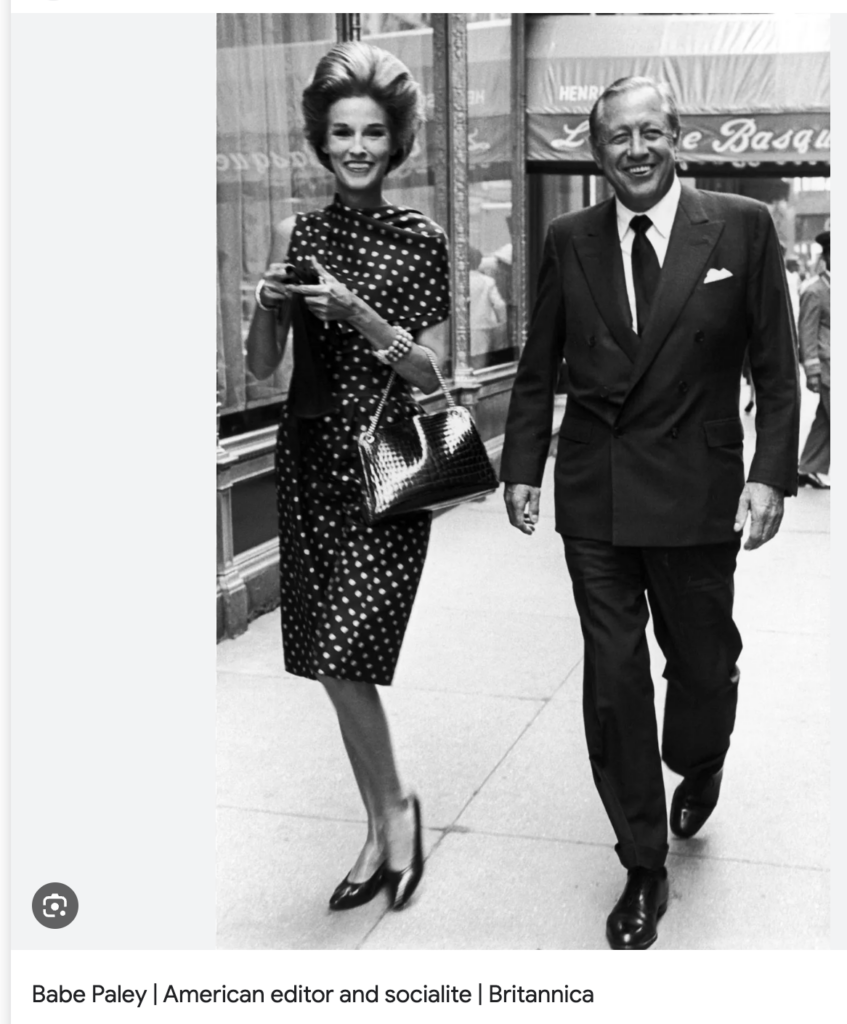
My inkling that self-supporting is the best path slowly but surely hardened into conviction as my world expanded through reading. I was especially intrigued when I read that CBS founder William Paley, once one of America’s richest and most influential men, treated his wife in a way that rang familiar. He would give her as much as USD 157K (in 1970s dollars) a year to spend on clothes – a well-dressed wife reflected well on him, after all – yet turn down her request for USD 900 to rent an art studio each month (in remission from cancer, she had wanted to focus more on her needs and yearned for her own space to pursue her hobby of sculpting). He would suddenly cancel her magazine subscriptions in the name of economy. These manoeuvres, concludes the notable biographer Sally Bedell Smith, “made Babe money-conscious, for all her jewels and designer dresses,” prompting her to do things improbable to someone of her station, like bragging about the money saved from buying artificial flowers. The writer Truman Capote, who was Babe Paley’s confidant for many years, had a more sinister take on her husband: “William Paley liked keeping the budget low because it made Babe more dependent and more supplicant to him.” Come to think of it, this may have been exactly why the father-in-law of my female relative was part Santa Claus, part Scrooge.
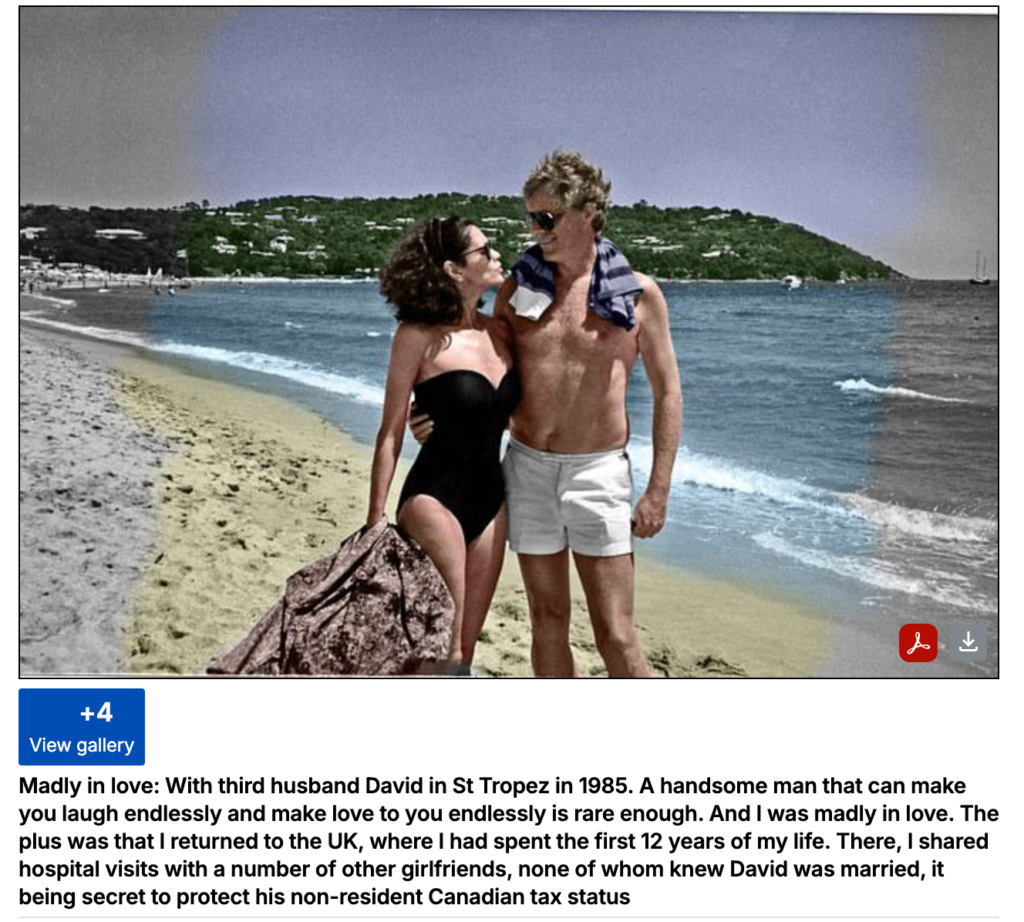
Some women find themselves married to men who are more Scrooge than Santa Claus after the fact. The British-Canadian writer Barbara Amiel thought she had snatched a catch when wealthy and handsome TV businessman David Graham agreed to marry her, only to discover what she had really gotten herself into on her wedding night. In a plush hotel suite filled with flowers and champagne, her new husband suddenly asked the bell boy to come up. It turned out he needed him to witness her signing the prenup, whose terms required her to give up her job and pension in return for, in the event of a divorce, a paltry settlement of CAD 200K (in 1980s dollars). “Sign it or I’ll leave,” he said, when she dithered. She signed. When they got divorced several years later, she got an even more paltry CAD 20,000.
On the internet, you can find a photo of Amiel and Graham vacationing in St. Tropez a year after their marriage. They are picture perfect: she in a strapless black bathing suit, a subdued version of Jessica Rabbit; he in white trunks, looking like a Greek god who had just emerged from the sea. They look into each other’s eyes, smiling. One would never have guessed their relationship was so fraught. Nor would one have guessed Amiel’s glamorous life was an illusion. In reality, she was little different from a houseguest being wined and dined at her host’s pleasure, indulging in luxuries that could be withdrawn at any moment.
Babe Paley did consider divorce once. When her writer friend Capote got wind of her intention, he, by his own account, pointed out two important facts to her. First, she had no money of her own. Second, she was scouted by her husband to play the role of his wife – “Bill bought you. It’s as if he went down to central casting” – so as long as she saw her wifely duties as a job, it wasn’t a bad deal at all, considering the extravagant lifestyle she got in return. Babe took a nap, woke up, and realized Capote was right.
At this stage of my argument building, my student should be able to draw her own conclusions about whether marrying rich is a good idea. If pleasing a manipulative man is a 24/7 job, then women who can stand on their own feet might as well find a real job. The hours are less brutal, and the options are more numerous (as long as our CVs are compelling enough, we can always ditch a toxic boss for a better one; ditching a toxic husband who is also one’s income source isn’t that easy). My student should also keep in mind that even though most financially independent women won’t be able to earn enough to enjoy Babe Paley’s annual wardrobe allowance – it would be worth USD 1.3 million in 2026 – if we want to immerse ourselves in sculpting or another hobby, we can do so without asking for permission. Ultimately, the greatest luxury of all is to be answerable to ourselves, not to a man who uses his checkbook as a leash.
Michelle Ng
英國牛津大學畢業,前《蘋果日報》和《眾新聞》專欄作家,現在身在楓葉國,心繫中國大陸和香港。
聯絡方式: michelleng.coach@proton.me
個人網站: https://michellengwritings.com